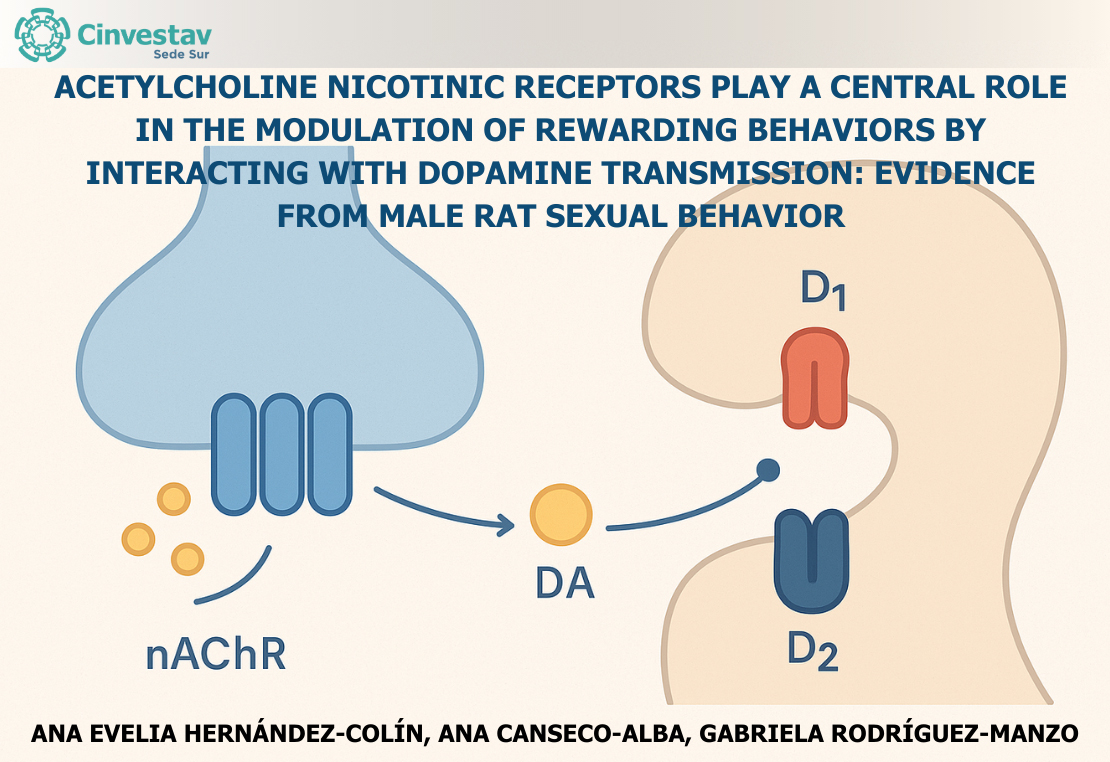
Acetylcholine nicotinic receptors play a central role in the modulation of rewarding behaviors by interacting with dopamine transmission: evidence from male rat sexual behavior
26 August 2025
Te invitamos a leer el articulo: Acetylcholine nicotinic receptors play a central role in the modulation of rewarding behaviors by interacting with dopamine transmission: evidence from male rat sexual behavior
Autores: Ana Evelia Hernández-Colín, Ana Canseco-Alba, Gabriela Rodríguez-Manzo
Abstract: Rationale Nicotinic acetylcholine receptors (nACh) are involved in the regulation of dopamine (DA) transmission at the mesolimbic (MSL) system, which regulates naturally rewarding behaviors like sexual behavior. Acetylcholine (ACh) and DA maintain a balance in the MSL system, which alteration impacts motivated behaviors. Copulation to satiety produces a sustained activation of the MSL system that triggers the instatement of a long-lasting sexual inhibitory period associated with a decreased sexual motivation.
Objective To determine if ACh contributes to the establishment and maintenance of the sexual inhibitory period of sexually
satiated male rats through the activation of nAChRs.
Methods Animals copulated to satiety in the presence of different doses of the nAChR antagonist mecamylamine (MEC), systemically administered, to determine nAChR involvement in the establishment of the sexual inhibitory state. The effect of different MEC doses on satiated rats was investigated to determine the role of nAChRs in maintaining the sexual inhibitory state. Combined treatments of MEC with a DA receptor agonist or antagonist were used to determine the possible interaction between DA and ACh.
Results nAChRs blockade during copulation to satiety interfered with the emergence of the sexual inhibitory state. In sexually satiated rats, nAChR antagonism reversed the sexual inhibition, an effect that was cancelled by a DA receptor antagonist.
Conclusions ACh is released during copulation to satiety and contributes to the instatement and maintenance of the sexual inhibitory state of sexually satiated rats through the activation of nAChR. DA is involved in the MEC-induced reversal of sexual satiety.
Keywords: Acetylcholine, Nicotinic receptors, Dopamine, Male rat sexual behavior, Sexual satiety, Sexual inhibition, Sexual motivation, Mecamylamine, Natural motivated behaviors